

Why Most Online Courses Fail You—And the AI System That Finally Fixed It for Me
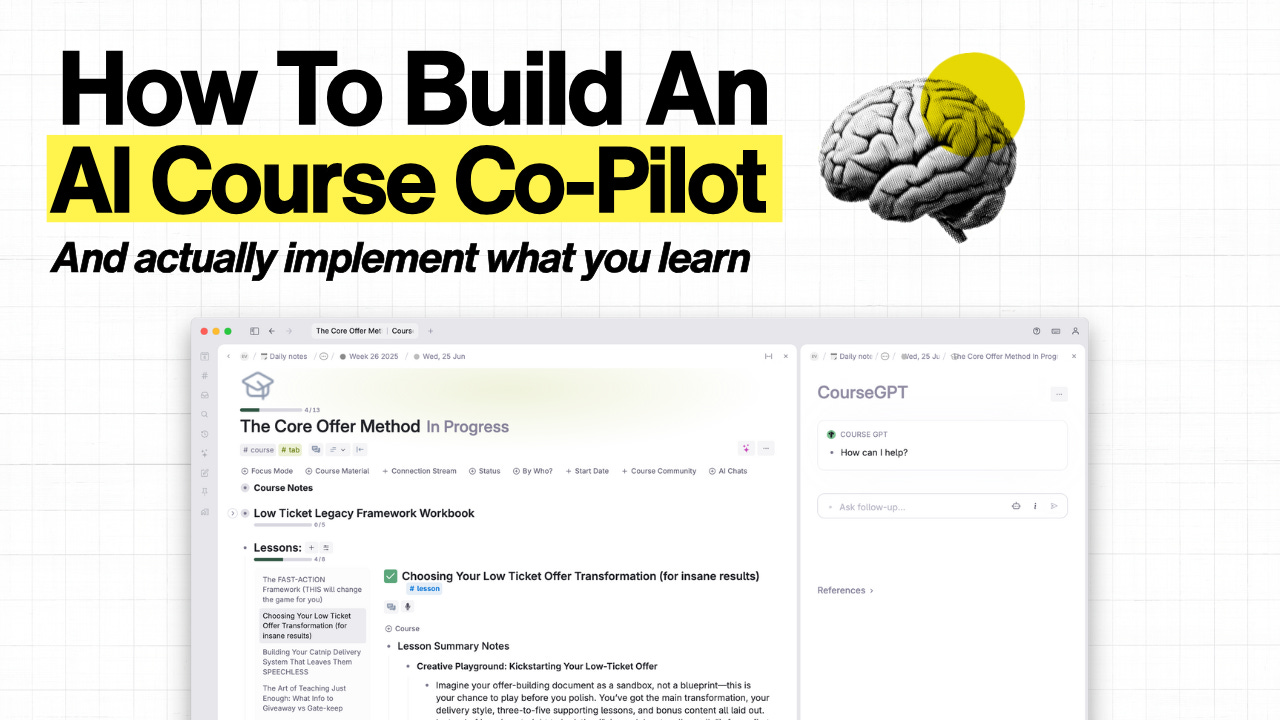
How to Build an AI Course Co-Pilot That Helps You Actually Implement What You Learn

Welcome to the Knowledge Work: Rebooted Newsletter. It’s been a few weeks since the last newsletter because I’ve been head down working on some big projects. But excited to be back to regular weekly programming now. Ev x
I used to be notorious for buying online courses and never finishing them.
You know the pattern: you get excited about a new course, watch the first few lessons with enthusiasm, take some notes, and then... life happens. The course sits there, half-finished, joining the graveyard of other abandoned learning projects.
And it has nothing to do with discipline or time management. There is something fundamentally unsatisfying about the traditional course experience right now.
The Problem With Online Courses in the AI Era
The way we consume online courses hasn't evolved much in the past decade. We still sit passively, watching videos taking some notes but essentially it's a one-way street of information transfer.
Meanwhile, the rest of our digital experience has become increasingly interactive and conversational. Most of us chat with AI Assistants multiple times a day going back and forth to solve problems, do work and learn new things.
This creates a fundamental disconnect in learning.
And it’s why you struggle to stay engaged with the courses you buy.
What I've discovered over the past year working heavily with AI is that there's something uniquely powerful about conversational learning. When we can ask questions, get clarification, and have a dialogue about things, we learn more deeply and retain information better.
So I built an AI Course Co-pilot that could help me not just finish courses, but be my learning partner through the process. And It's been amazing. Not only am I finishing courses, I feel so engaged in the whole process as I watch videos and then chat with my course copilot about the content.
It's like having the instructor with me 24/7.
How to Build Your Own AI Course Co-Pilot
You don't need a specific tool to build your own copilot. Just a few tools you probably are already using to bring this together. Here's the simple three-step process I use:
Step 1: Transcribe as You Watch/Listen
Most of us are familiar with some kind of meeting transcription tool. But you don't have to stop at just meetings. They work just as well transcribing a video you are watching from a course lesson. Which is exactly what I do. While I watch the course lesson, I switch on my meeting note-taker (I suggest something like Tana or Granola or Notion) and it transcribes the course content for me.
I still take my own notes because that also keeps me engaged while I watch.
Step 2: Run the FriendGPT Prompt
Then for each lesson transcript, I run what I call the "FriendGPT" prompt. I designed this prompt to be like that friend in school who used to take the best notes in class and lend them to you for studying.
You’ll receive a transcript of a lesson, podcast, or video. Your job is to write a summary that feels like a smart friend is explaining the key ideas to me — not just listing them. Structure it like personal notes I’ll want to come back to. Use headings and short paragraphs. Explain not just what was said, but why it matters and how to apply it. Add examples if needed. Keep it engaging, clear, and human — like someone who really gets it is breaking it down for me. Avoid dry bullet points or passive tone. I want to enjoy reading these notes and be able to create from them later.

✍️ Use headings, subheadings, and short skimmable paragraphs
🤝 Write in a conversational tone, like a colleague explaining it back
💡 Explain frameworks clearly — what they are, why they work, and how to use them
📌 Include examples if the source mentioned them (or make one up if helpful)
🧠 Add “remember this” callouts to highlight big takeaways
🛑 Avoid flat lists unless you’re summarising prompts or steps
🔁 End with a recap or suggested action steps

My notes:
The result is notes unlike any I could write myself, with different insights and perspectives that help me see the material in a new light. It's like having a study buddy who watched the same lesson and is explaining it back to you in their own words.
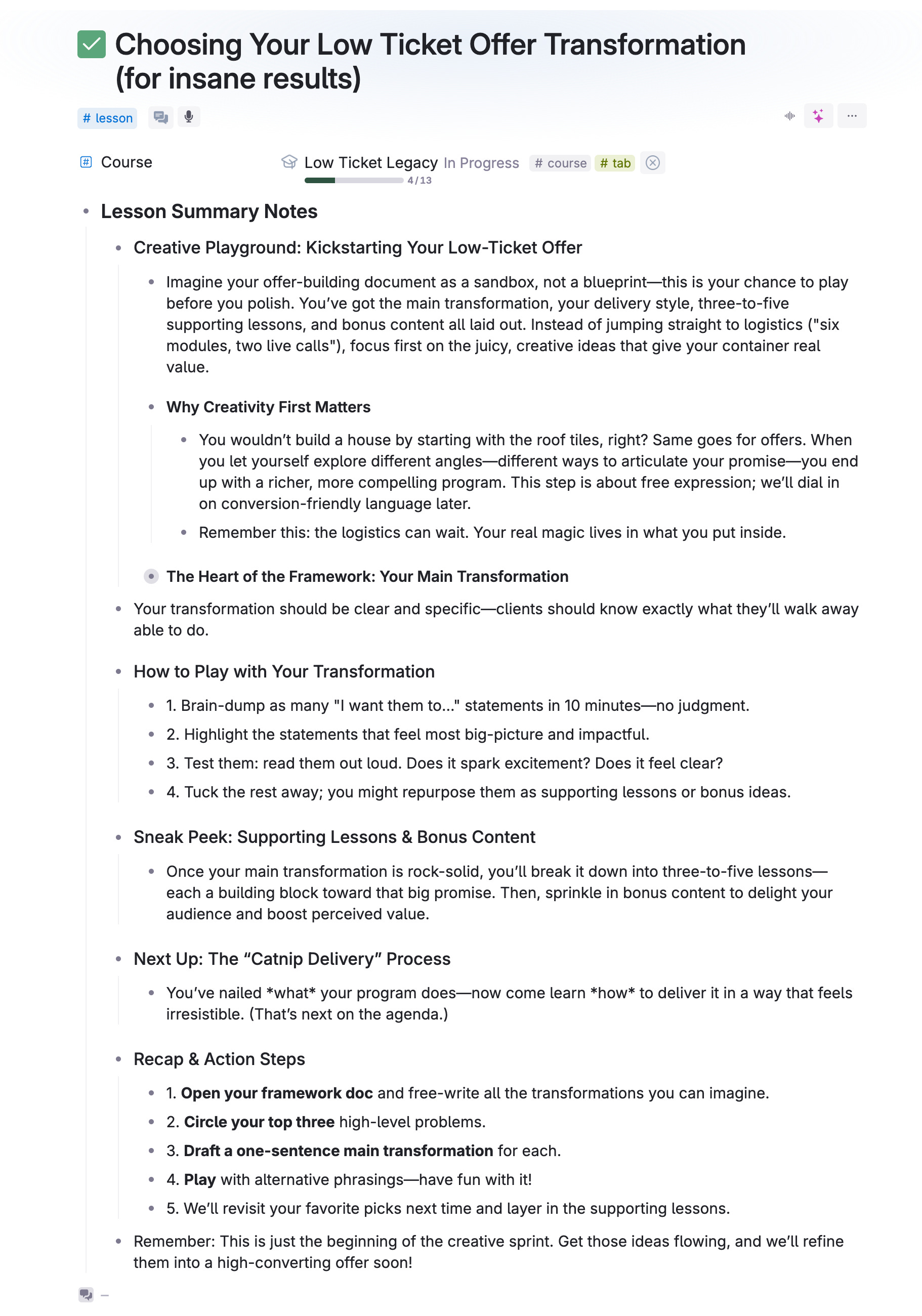
By the time I've watched the lesson, taken my own notes AND read over the notes from AI I've got a much deeper understanding of the course content.
Step 3: Compile Everything into an AI Chat
Now, take your transcripts and FriendGPT notes and compile them into a Claude or ChatGPT project or ChatGPT conversation. This creates your interactive learning environment and you can start interacting with the course content in ways that were never possible before:
→ Ask questions about concepts you don't fully understand
→ Get help with exercises from the course instructor (my favourite is to work through the workbook exercises of a course with my copilot)
→ Brainstorm how you can implement the course content
→ One of my clients is even using it to quiz him on the course content to make sure he understands it fully!
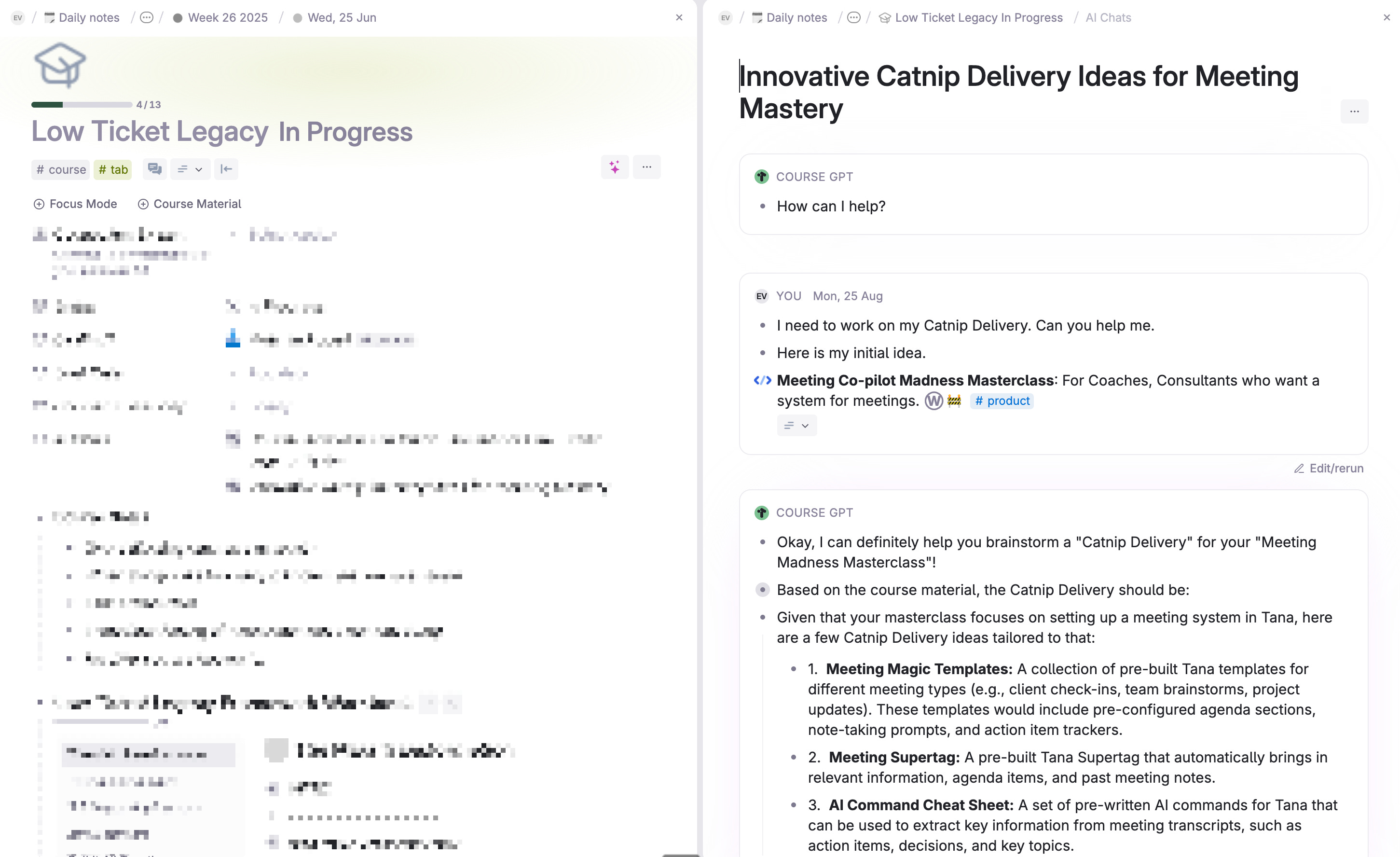
The system transforms a one-way video into a two-way conversation. The course becomes a living, interactive experience rather than a static set of videos.
How Tana Makes This System Even Better
While you can build a course co-pilot in any combination of tools, I've built mine in Tana and it's like it was designed for workflows like this.
Tana combines note-taking, meeting note-taker and AI together which allows you to build an all in one system for things like the course copilot.
If you want to see how I built (& use) this in Tana I filmed a video earlier this month about it:
But as I said… you could easily set this same system up in Notion, using Granola + your favourite LLM tool. Use the tool that suits you best.
Since building this system, my relationship with online courses has completely changed:
1. I finish courses now. The interactive nature keeps me engaged throughout.
2. I retain more information. Conversational learning helps concepts stick.
3. I implement what I learn. The system bridges the gap between theory and practice.
4. I enjoy the learning process. It feels like having a study group rather than sitting alone watching videos.
The passive experience of traditional online courses just doesn't cut it for me anymore. Once you've had a conversation with your course content instead of just watching it, you'll never want to go back to the old way of learning.
And if you're interested in giving this a go in Tana, I created a course copilot template that you can install and get this up and running instantly. Check it out here.
Whenever You're Ready To Build A Personal Knowledge Copilot That Actually Keeps up With Your Pace Of Work — Here Are Couple Of Ways I Can Help:
Subscribe to Knowledge Work: Rebooted for weekly workflows, frameworks, tools, agents & prompts to help you build an intelligent personal knowledge system built for the way we do work now.
If you want to build a knowledge management system that actually surfaces your best ideas (rather than being a second job) then check out Knowledge Alchemy. It’ll teach you how to setup a note-taking practice that feels like exploration, not homework.
I recently did a workshop on how to build a sense-making knowledge system by taking the work you do everyday and using AI to be a ‘sense-maker’ in the chaos. You can checkout the recoding here.
How are you keeping this content (which is copyrighted from the owner) from being used to train the larger LLM?
💙💙💙